What Are Google's AI Search Features and How Do They Work?
2026-06-17
TL;DR
You pulled up Google to research something for your business and got a paragraph of generated text before a single blue link appeared. You did not ask for a summary. The page gave you one anyway.
Most people assume AI search works like a chatbot that reads one article and paraphrases it. That assumption leads to wrong conclusions about what content gets surfaced, who controls it, and why some queries trigger it and others do not.
Google's AI search features use large language models to expand your query, pull from dozens of indexed pages simultaneously, and return a synthesized answer with supporting links. Site owners who understand the actual indexing and snippet rules can make informed decisions about whether and how their content appears. This article explains the mechanics without hype.
* * *
How does Google's AI search work?
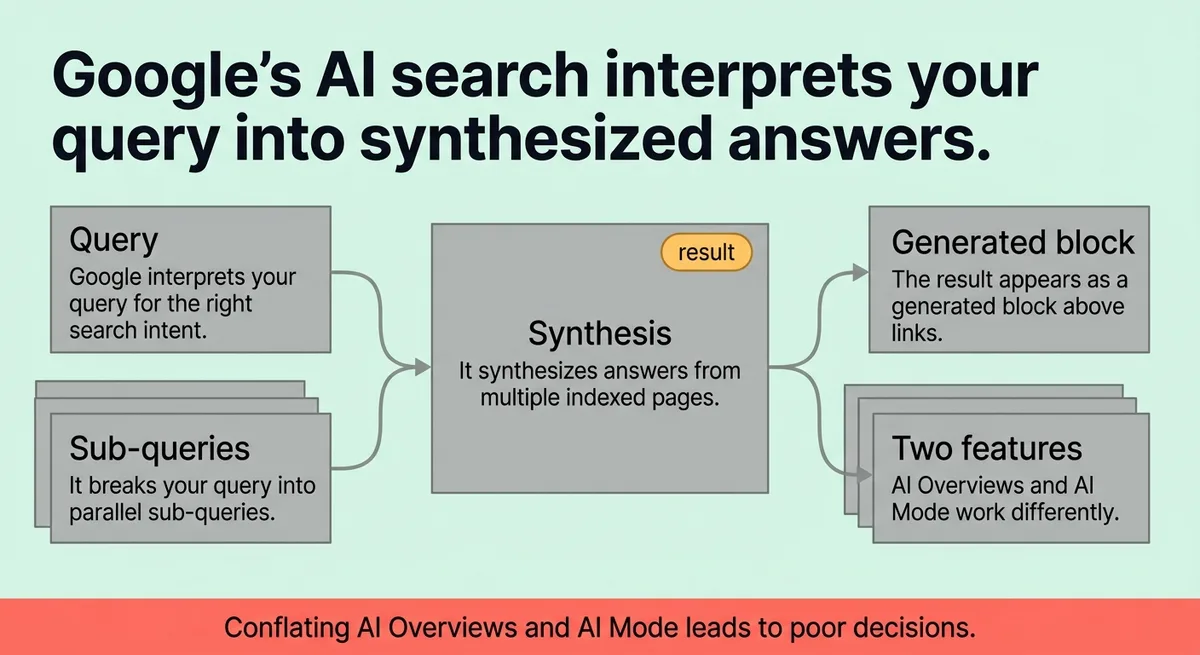
Google's AI search interprets your query, breaks it into parallel sub-queries, and synthesizes answers from multiple indexed pages. The result appears as a generated block above standard links. Two distinct features deliver this experience: AI Overviews and AI Mode. Each works differently, and conflating them leads to poor decisions about content and search behavior.
* * *
The Two Core AI Search Experiences Google Has Released
Google has released two AI-powered search features, and they are not the same product [\[2\]](#ref-2).
Treating them as interchangeable is the first mistake most site owners make. One is a default layer baked into standard search results. The other is a separate, opt-in research mode built for complex queries.
AI Overviews appear automatically in standard Google Search results. They generate a summarized answer at the top of the page for eligible queries. Google has expanded AI Overviews to over 200 countries and territories [\[5\]](#ref-5), across more than 40 languages [\[3\]](#ref-3). This is not a beta feature. It runs for all users in the U.S. [\[3\]](#ref-3) and has reached hundreds of millions of users globally [\[4\]](#ref-4).
AI Mode is a separate tab inside Google Search. It launched in the United States in May 2025 [\[1\]](#ref-1) and runs on Gemini 2.0 [\[1\]](#ref-1). It targets users who want to research multi-part questions or complete tasks that require synthesizing many sources at once. It draws from dozens of sources in a single session [\[1\]](#ref-1).
Here is how the two features compare at a functional level:
<table class="border-collapse w-full my-4 table-auto mx-4 max-w-4xl sm:mx-auto" style="min-width: 100px;"><colgroup><col style="min-width: 25px;"><col style="min-width: 25px;"><col style="min-width: 25px;"><col style="min-width: 25px;"></colgroup><tbody><tr><th class="border border-border px-4 py-3 bg-muted font-semibold text-left" colspan="1" rowspan="1"><p>Feature</p></th><th class="border border-border px-4 py-3 bg-muted font-semibold text-left" colspan="1" rowspan="1"><p>Default or Opt-In</p></th><th class="border border-border px-4 py-3 bg-muted font-semibold text-left" colspan="1" rowspan="1"><p>Geographic Reach</p></th><th class="border border-border px-4 py-3 bg-muted font-semibold text-left" colspan="1" rowspan="1"><p>Underlying Model</p></th></tr><tr><td class="border border-border px-4 py-3" colspan="1" rowspan="1"><p>AI Overviews</p></td><td class="border border-border px-4 py-3" colspan="1" rowspan="1"><p>Default in standard search</p></td><td class="border border-border px-4 py-3" colspan="1" rowspan="1"><p>120+ countries and territories <a rel="noopener noreferrer nofollow" class="text-primary underline citation-link" href="#ref-5">[5]</a>, 11 languages <a rel="noopener noreferrer nofollow" class="text-primary underline citation-link" href="#ref-5">[5]</a></p></td><td class="border border-border px-4 py-3" colspan="1" rowspan="1"><p>Not publicly specified</p></td></tr><tr><td class="border border-border px-4 py-3" colspan="1" rowspan="1"><p>AI Mode</p></td><td class="border border-border px-4 py-3" colspan="1" rowspan="1"><p>Opt-in tab</p></td><td class="border border-border px-4 py-3" colspan="1" rowspan="1"><p>U.S. launch, May 2025 <a rel="noopener noreferrer nofollow" class="text-primary underline citation-link" href="#ref-1">[1]</a></p></td><td class="border border-border px-4 py-3" colspan="1" rowspan="1"><p>Gemini 2.0 <a rel="noopener noreferrer nofollow" class="text-primary underline citation-link" href="#ref-1">[1]</a></p></td></tr></tbody></table>
The practical distinction matters for site owners. AI Overviews affect the vast majority of searches today. AI Mode affects a smaller, research-oriented segment right now, but it signals where the default experience is heading.
Stop thinking of these as two versions of the same thing. Start treating them as two separate surfaces with different triggers and different user intent behind each.
* * *
How the System Actually Processes Your Query: The Fan-Out Model
Most people picture AI search as a single read-and-summarize operation. That is not how it works.
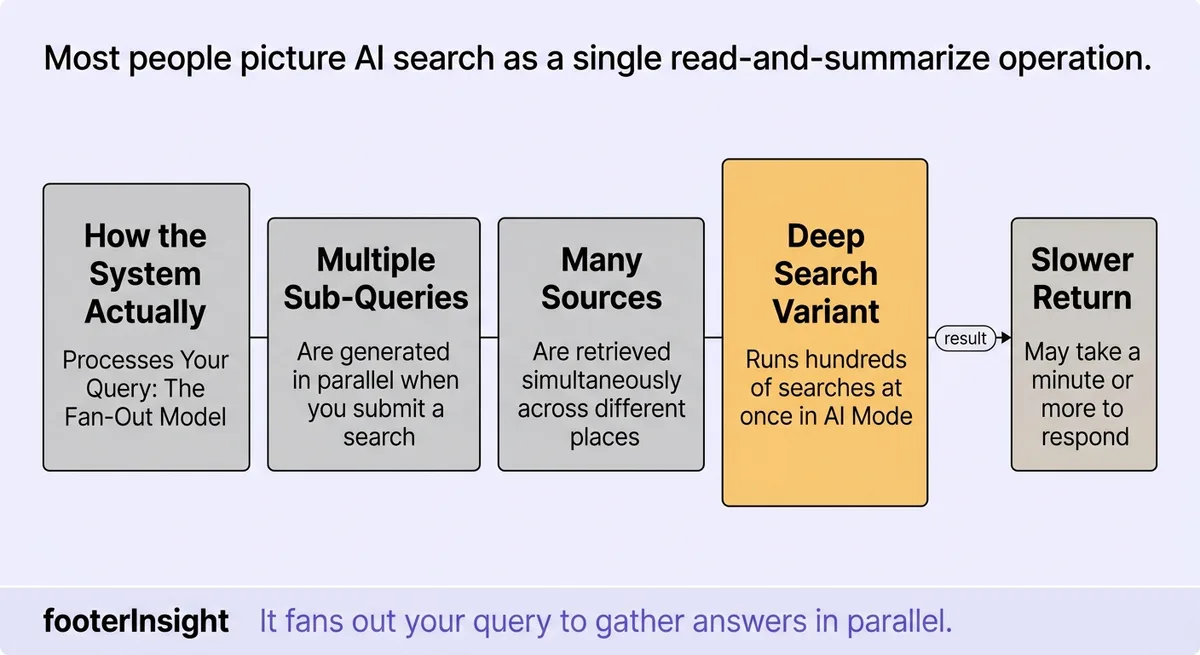
The actual mechanism is called query fan-out [\[1\]](#ref-1). When you submit a search, the system does not look for one answer in one place. It generates multiple sub-queries in parallel [\[1\]](#ref-1) and retrieves information across many sources simultaneously. Deep Search, the more intensive research variant inside AI Mode, runs hundreds of searches at once [\[1\]](#ref-1)[\[3\]](#ref-3) and may take a minute or more to return results [\[1\]](#ref-1).
This changes what "accuracy" means in practice.
The answer you see is a synthesis across many inputs, not a quote from one page. That has real consequences. If five sources say the same thing incorrectly, the generated answer will likely reflect that error. If a niche but accurate source says something different, it may get outvoted by the weight of the other inputs.
Think of it this way: the system is not reading one article for you. It is running a rapid survey across dozens of pages and writing a summary of what most of them say.
The fan-out model changes how you should evaluate AI-generated answers. Ask yourself which sources likely contributed. Check whether the supporting links reflect a range of perspectives or a cluster of similar ones. The supporting links shown below the generated block are not the only sources the system consulted. They are a subset selected for display.
Here is what the process looks like in sequence:
<table class="border-collapse w-full my-4 table-auto mx-4 max-w-4xl sm:mx-auto" style="min-width: 75px;"><colgroup><col style="min-width: 25px;"><col style="min-width: 25px;"><col style="min-width: 25px;"></colgroup><tbody><tr><th class="border border-border px-4 py-3 bg-muted font-semibold text-left" colspan="1" rowspan="1"><p>Stage</p></th><th class="border border-border px-4 py-3 bg-muted font-semibold text-left" colspan="1" rowspan="1"><p>What Happens</p></th><th class="border border-border px-4 py-3 bg-muted font-semibold text-left" colspan="1" rowspan="1"><p>User Implication</p></th></tr><tr><td class="border border-border px-4 py-3" colspan="1" rowspan="1"><p>Query interpretation</p></td><td class="border border-border px-4 py-3" colspan="1" rowspan="1"><p>System rewrites your query into sub-queries</p></td><td class="border border-border px-4 py-3" colspan="1" rowspan="1"><p>Your original wording shapes but does not control the result</p></td></tr><tr><td class="border border-border px-4 py-3" colspan="1" rowspan="1"><p>Parallel retrieval</p></td><td class="border border-border px-4 py-3" colspan="1" rowspan="1"><p>Hundreds of indexed pages are pulled simultaneously <a rel="noopener noreferrer nofollow" class="text-primary underline citation-link" href="#ref-3">[3]</a></p></td><td class="border border-border px-4 py-3" colspan="1" rowspan="1"><p>No single source dominates</p></td></tr><tr><td class="border border-border px-4 py-3" colspan="1" rowspan="1"><p>Synthesis</p></td><td class="border border-border px-4 py-3" colspan="1" rowspan="1"><p>LLM generates a summarized answer from retrieved content</p></td><td class="border border-border px-4 py-3" colspan="1" rowspan="1"><p>Answer may smooth over conflicting details</p></td></tr><tr><td class="border border-border px-4 py-3" colspan="1" rowspan="1"><p>Display</p></td><td class="border border-border px-4 py-3" colspan="1" rowspan="1"><p>Supporting links are selected for visibility</p></td><td class="border border-border px-4 py-3" colspan="1" rowspan="1"><p>Shown links are not the full source list</p></td></tr></tbody></table>
The fan-out model is worth naming because it reframes a common frustration. Many users assume the AI search result is wrong because the system "misread" one article. More often, the system read many articles accurately and weighted majority consensus over outlier accuracy.
* * *
You Probably Think AI Search Ignores Your Site , Here Is What the Data Actually Shows
Here is the false assumption worth exposing: many site owners believe AI search requires some special technical integration or schema markup to include their content.
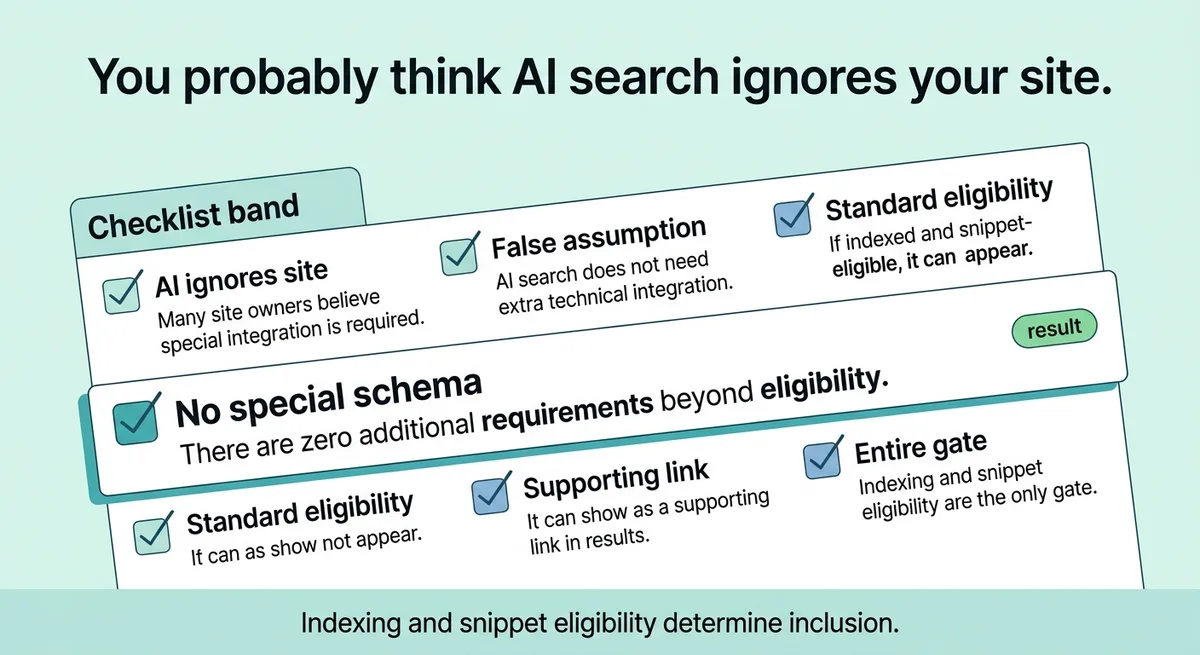
It does not. There are zero additional technical requirements beyond standard search eligibility [\[2\]](#ref-2). If your page is indexed and eligible for a snippet, it is eligible to appear as a supporting link in AI search results [\[2\]](#ref-2). That is the entire gate.
Google's documentation makes this explicit. A page must be indexed and snippet-eligible to qualify for inclusion [\[2\]](#ref-2). Nothing else is required. No additional structured data. No special AI-readiness audit. No enrollment.
What you can control is the opposite direction. You can restrict your content from appearing. Google provides four preview-control options [\[2\]](#ref-2):
- nosnippet: Blocks the page from generating any snippet.
- data-nosnippet: Blocks a specific HTML element from appearing in snippets.
- max-snippet: Limits the character length of the snippet.
- noindex: Removes the page from the index entirely, which removes it from all search features.
These controls exist for publishers who have editorial or legal reasons to limit content exposure. They are not optimization levers. Using nosnippet does not improve your ranking. It removes your eligibility.
One important caveat on timing: crawling delays can range from several days to several months [\[2\]](#ref-2). A page you published or updated recently may not yet reflect your current content in AI-generated answers. This is not a bug. It is the standard crawl cycle applied to a newer surface.
To measure whether AI search is driving visits, use Search Console. Visits from AI search features appear in the Performance report under the Web search type [\[2\]](#ref-2). You will not see a separate AI filter in most reporting views. The data sits within the existing web search category.
One content team spent three months adding structured data to pages they believed were excluded from AI Overviews. After auditing the Search Console data, they found those pages were already appearing as supporting links. The real issue was crawl delay on recently updated pages, not a technical eligibility problem. They stopped adding markup and started updating content on a regular publishing schedule instead. Supporting link appearances became consistent within two months.
* * *
What AI Search Changes for the People Using It Every Day
AI search does not just change how answers look. It changes how discovery works.
Google has indexed the web for 25 years [\[4\]](#ref-4) and built a knowledge base representing billions of facts [\[4\]](#ref-4). AI search layers a synthesis capability on top of that foundation. The result is that users can now get a structured answer to a multi-part question without clicking through to individual pages.
For everyday users, this has three practical effects.
First, task completion happens faster. A query like "what documents do I need to transfer a car title in Texas" used to require reading two or three pages to reconcile slightly different answers. AI search synthesizes those answers into one block. Time saved is real, but so is the risk of homogenized output.
Second, source exposure has changed. Users who previously saw ten blue links and chose which to visit now see a generated block first. The sources that appear as supporting links below the block receive visibility, but the dynamic is different from ranking position 1 through 10. A page shown as a supporting link may get fewer clicks than a page that ranked first in a traditional results layout.
Third, verification behavior matters more now. Google plans to reach over a billion people with these features by the end of the year [\[4\]](#ref-4). At that scale, errors in generated answers propagate quickly. Users who treat the generated block as a final answer, rather than a starting point, carry higher risk of acting on incomplete or synthesized-over detail.
The practical adjustment is straightforward. Read the supporting links, not just the generated block. The block is a summary. The pages behind it contain the context, the caveats, and the specifics the summary may have dropped.
AI search has been tested with hundreds of millions of users already [\[4\]](#ref-4). The patterns that have emerged show that users trust synthesized answers at high rates. That trust is not always calibrated to accuracy. Building the habit of checking supporting sources closes the gap.
* * *
What Google's AI Search Shift Means for How Answers Get Trusted
The fan-out model and the synthesis layer change the trust relationship between users and search results.
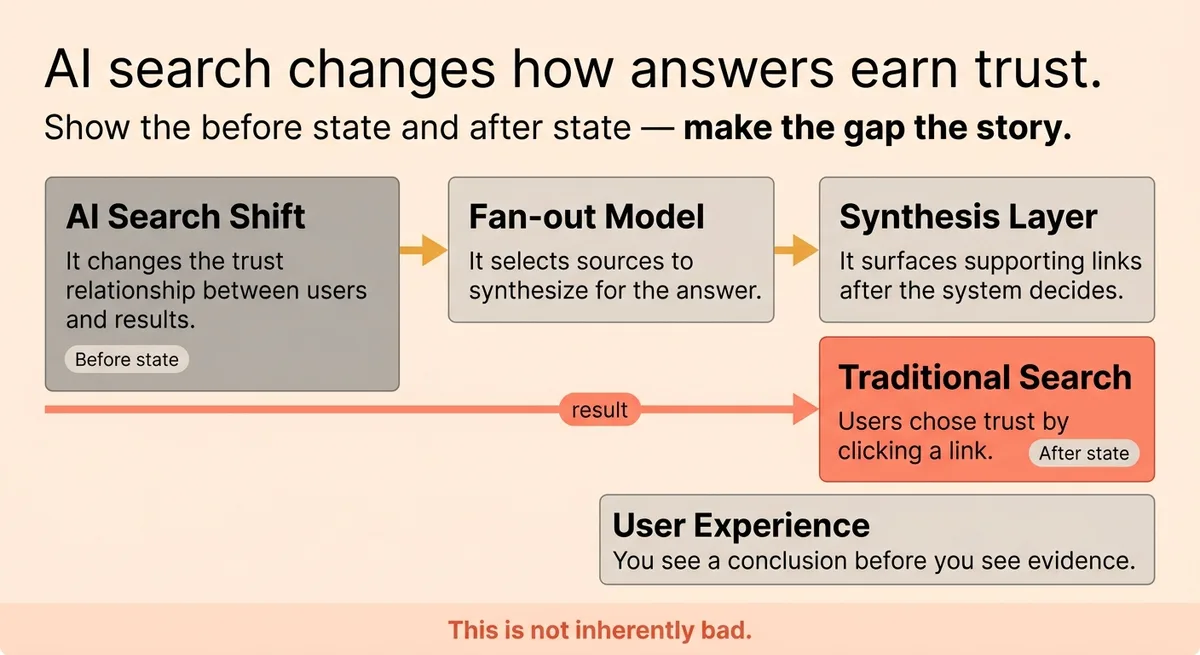
With traditional search, a user chose which source to trust by deciding which link to click. With AI search, the system makes a partial trust decision on the user's behalf by selecting which sources to synthesize and which to surface as supporting links. The user sees a conclusion before they see the evidence.
This is not inherently bad. It is fast, and for low-stakes queries it is accurate enough to save real time. The issue is calibration.
For site owners, the mechanics are clear. Index eligibility and snippet eligibility determine inclusion [\[2\]](#ref-2). The four preview controls determine exclusion [\[2\]](#ref-2). Nothing else has changed on the technical side. Publishing accurate, crawlable, snippet-eligible content remains the correct approach.
For users, the fan-out model is the key mental model to carry. Hundreds of searches run in parallel [\[1\]](#ref-1)[\[3\]](#ref-3). The answer you see is a weighted synthesis. When the stakes of the decision are high, check the supporting links. The generated block is a compressed starting point, not a primary source.
Google's AI search expansion has reached over 120 countries and territories in AI Overviews alone [\[5\]](#ref-5) and continues to expand. The question is not whether to engage with it. The question is whether you understand what produces the answer you are reading.
Read the sources. That has always been the right move.
* * *
FAQ
How does Google's AI search work?
Google's AI search uses a process called query fan-out to generate multiple sub-queries from your input and retrieve information from many indexed pages simultaneously [\[1\]](#ref-1). A large language model synthesizes those results into a generated answer block. Supporting links appear below the block, though they represent a selection of the sources consulted, not all of them.
Is Google AI search free to use?
AI Overviews appear automatically in standard Google Search at no cost to users. AI Mode, the separate research-focused tab, is also available without a fee for users in the United States as of its May 2025 launch [\[1\]](#ref-1). No subscription is required to access either feature.
What triggers Google AI search?
Google determines query eligibility based on its own signals, which it has not fully disclosed. Queries that appear to benefit from synthesized multi-source answers are more likely to trigger an AI Overview. Conversational, research-oriented, and multi-part questions are common triggers, though the system applies to broad query categories at scale.
What is the difference between Google search and AI search?
Traditional Google Search returns a ranked list of links. AI search generates a synthesized answer block above those links, drawing from multiple sources via the fan-out model [\[1\]](#ref-1). The underlying index is the same. The retrieval and display layer is different.
Is ChatGPT better than Google AI?
They serve different functions. ChatGPT is a conversational model trained on a static dataset up to a cutoff date. Google's AI search features pull from the live, continuously crawled web index [\[4\]](#ref-4). For current information and source attribution, Google's system has structural advantages. For extended reasoning or creative tasks, ChatGPT operates differently.
What to never ask Google Assistant?
Google Assistant is a separate product from Google's AI search features. No category of questions is technically blocked. Avoid relying on any AI-generated answer for medical, legal, or financial decisions without verifying the response against the original sources cited.
Is there a fee for Google AI?
No fee applies to AI Overviews or AI Mode in their current rollout. Both are available as part of standard Google Search. Google has not announced a paid tier for these specific search features.
What should I avoid searching on Google?
There are no categories that Google blocks users from searching. The practical caution is different: for high-stakes topics, the generated answer block summarizes many sources and may smooth over important nuance. Read the supporting links directly rather than acting on the synthesized summary alone.
* * *
References and Citations
[\[1\]](#ref-1) [https://www.mindstudio.ai/blog/google-ai-search-mode-workflows-agents](https://www.mindstudio.ai/blog/google-ai-search-mode-workflows-agents)
[\[2\]](#ref-2) [https://developers.google.com/search/docs/appearance/ai-features](https://developers.google.com/search/docs/appearance/ai-features)
[\[3\]](#ref-3) [https://www.searchenginejournal.com/google-expands-ai-features-in-search-what-you-need-to-know/547176/](https://www.searchenginejournal.com/google-expands-ai-features-in-search-what-you-need-to-know/547176/)
[\[4\]](#ref-4) [https://blog.google/products-and-platforms/products/search/generative-ai-google-search-may-2024/](https://blog.google/products-and-platforms/products/search/generative-ai-google-search-may-2024/)
[\[5\]](#ref-5) [https://search.google/ways-to-search/ai-overviews/](https://search.google/ways-to-search/ai-overviews/)